



Before you go...
Learn how you can transform your data into business breakthroughs with RapidCanvas

Build an adaptive, resilient supply chain with AI-powered disruption prediction and response that minimizes impact, accelerates recovery, and ensures business continuity.
PhD data scientists and industry veterans analyze your goals, data sources, business processes, and tech stack to architect a customized solution in collaboration with you. They then leverage 500+ pre-built AI agents and integrations to deliver real AI transformation 10X faster than traditional software development.
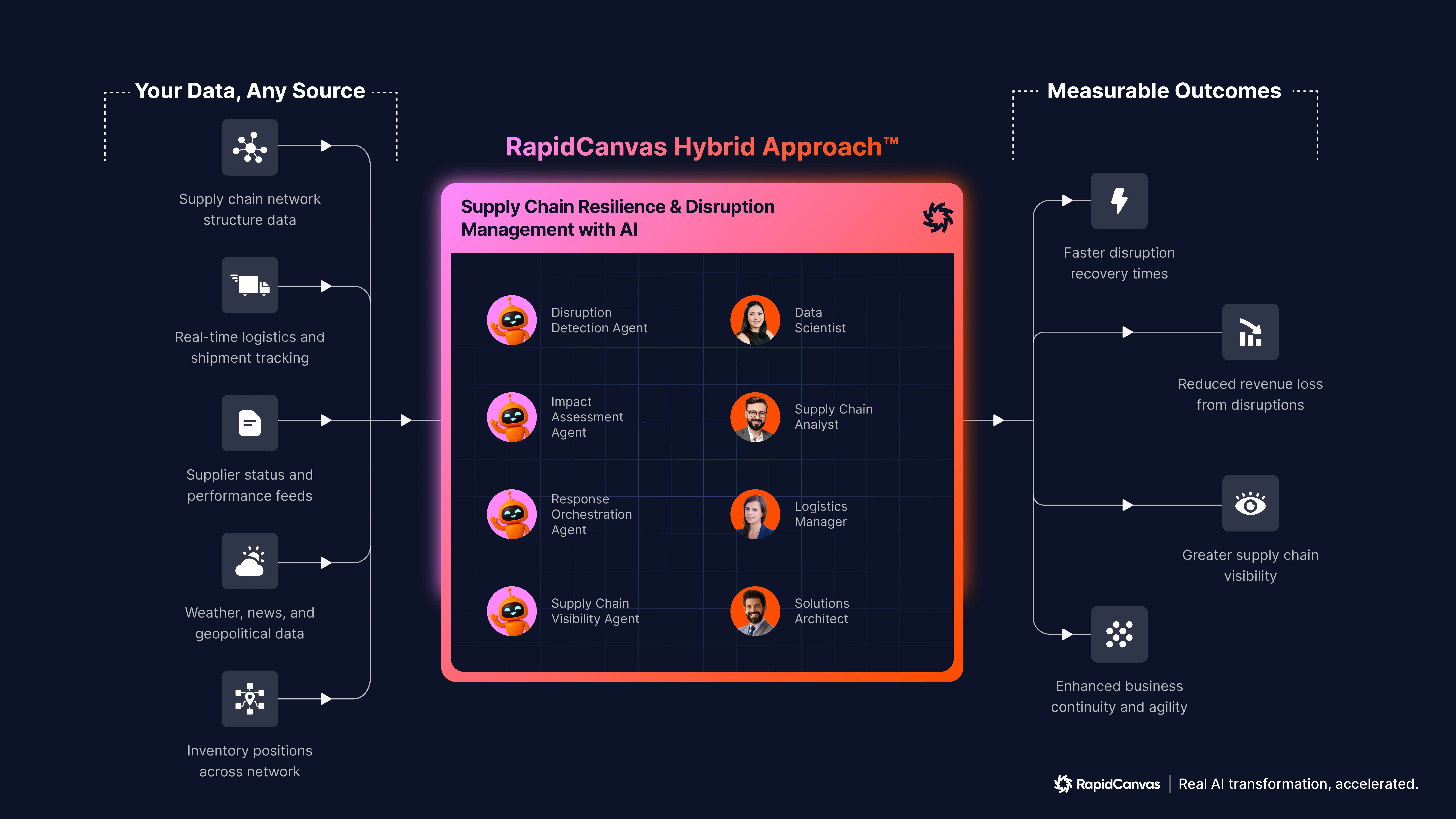

AI monitors global events, supplier networks, logistics patterns, and market conditions to identify potential disruptions days or weeks before they impact your operations.
.webp)
Machine learning rapidly evaluates disruption scenarios across your supply chain, quantifying impacts to production, revenue, and customer commitments while identifying critical vulnerabilities.
AI-powered recommendations for alternative suppliers, logistics routes, inventory reallocation, and production adjustments that minimize disruption impact and accelerate recovery.

Organizations typically achieve 40-60% reduction in disruption recovery time, 25-40% decrease in revenue loss from supply chain events, and 30-50% improvement in supply chain visibility.


Get real AI transformation with a unique process that speeds outcomes 10X faster than custom software development. Start driving positive ROI in 4-8 weeks.






RapidCanvas cuts long AI development timelines from months to weeks, enabling business teams to realize impact almost immediately.
Our solution-driven approach minimizes dependency on costly custom development and technical teams.
With intuitive workflows and AI-assisted automation, business users can lead initiatives that once required deep technical expertise.

From discovery to launch and continuous optimization, RapidCanvas owns the entire process to deliver secure, compliant, and high-quality AI solutions.
.webp)
Transparent subscription pricing and measurable outcomes ensure you get reliable value without surprises—backed by a risk-free trial.

Secure, standardized enterprise-grade deployments with transparent and compliant workflows and shared visibility for IT and business teams.
RapidCanvas stacks up strongly against other AI industry leaders based on objective, independent research and verified user reviews.
Get in touch for an expert consultation.

AI-powered disruption management continuously monitors thousands of signals across your supply chain ecosystem—supplier status, logistics networks, weather patterns, geopolitical events, port congestion, labor actions, and market dynamics. Advanced machine learning models identify patterns that precede disruptions, providing early warnings before events impact operations. When disruptions occur, the AI instantly assesses cascading impacts across your network, simulates recovery scenarios, and recommends optimal response strategies. The system evaluates alternative suppliers, logistics routes, inventory positioning, and production schedules to minimize business impact while considering cost, timing, and feasibility constraints.
AI solutions help manage virtually all supply chain disruption types including supplier failures, natural disasters, geopolitical events, transportation delays, port congestion, labor strikes, quality issues, demand shocks, cyber incidents, and pandemics. The system handles both acute disruptions (sudden events requiring immediate response) and chronic issues (persistent problems requiring strategic adjustment). Whether dealing with single-point failures or complex multi-factor scenarios, the AI adapts its response recommendations to disruption type, severity, and your organization's specific vulnerabilities and priorities.
Organizations typically see initial value within 8-12 weeks of implementation. Early disruption warnings begin as the AI learns your supply chain network and starts monitoring risk signals. The first prevented or mitigated disruption often occurs within 2-4 months, demonstrating clear ROI. Response time improvements become measurable immediately as teams access AI-powered impact assessments and recovery recommendations instead of manual analysis. Long-term resilience benefits—reduced frequency and severity of disruptions—emerge over 6-12 months as the system enables proactive risk mitigation and network optimization.
Yes, RapidCanvas integrates with supply chain planning systems, transportation management systems (TMS), warehouse management systems (WMS), ERP platforms, supplier portals, and logistics tracking systems. Our solution accesses real-time data about inventory positions, shipment status, production schedules, and supplier performance. The system also connects to external data sources including weather services, news feeds, port data, flight tracking, and geopolitical risk databases. Integration enhances your existing supply chain visibility and control tower capabilities without replacing current systems.
The AI continuously analyzes patterns across multiple data streams to identify leading indicators of potential disruptions. For example, it might detect unusual port congestion patterns suggesting delays, supplier financial stress indicating potential failures, or weather systems threatening transportation corridors. The system recognizes subtle signals—like increasing lead times, quality variance, or supplier communication changes—that human analysts might miss or dismiss. Machine learning models trained on historical disruptions identify similar patterns emerging in current data. Early warnings include predicted timing, likelihood, potential impact, and recommended preventive actions.
RapidCanvas provides complete visibility into disruption analysis and response recommendations. You can see exactly which factors are driving risk assessments, how the AI calculated impact estimates, why specific alternatives are recommended, and what trade-offs exist between options. The system displays disruption scenarios with timeline projections, affected products and customers, cost implications, and feasibility constraints. Visual network maps show cascading impacts and critical paths. This transparency allows supply chain teams to understand AI reasoning, adjust recommendations based on considerations the AI might not capture, and make confident decisions under pressure.
Absolutely. The platform scales seamlessly as you add suppliers, expand into new markets, increase product lines, or grow distribution networks. The system handles supply chain complexity across multiple tiers, geographies, and business units without performance degradation. As your network expands, the AI actually becomes more powerful, identifying optimization opportunities and risk mitigation strategies across your broader ecosystem. The architecture supports everything from regional supply chains to global multi-tier networks with thousands of nodes, providing consistent visibility and control regardless of scale.
Supply chain resilience directly impacts business performance by preventing revenue loss from stockouts, maintaining customer commitments during disruptions, avoiding expediting costs, and protecting brand reputation. Resilient supply chains adapt quickly to changes, enabling competitive advantage through reliability. Improved visibility reduces safety stock requirements while increasing service levels. Faster disruption recovery minimizes production downtime and customer impact. Organizations with resilient supply chains capture market share when competitors struggle with disruptions, command premium pricing through superior reliability, and demonstrate lower risk profiles to investors and customers.
Essential data includes supply chain network structure (suppliers, facilities, customers), material flows and lead times, inventory positions, production schedules, and transportation routes. Additional valuable data includes supplier dependencies, alternative source options, capacity constraints, cost structures, customer priorities, and historical disruption events. The system enriches your internal data with external sources including weather forecasts, news feeds, logistics tracking, port data, and risk databases. More comprehensive data enables more sophisticated scenario analysis, but RapidCanvas delivers value even with basic supply chain visibility. Our team helps prioritize data sources during implementation.
The AI system continuously refines its disruption prediction models by analyzing actual events versus predictions. It learns which signals most reliably predict different disruption types in your specific supply chain, which response strategies prove most effective, and how your network behaves under stress. The system adapts to changes in your supply chain structure, supplier relationships, and business priorities. Over time, prediction accuracy improves, false alerts decrease, and response recommendations align more closely with your organization's capabilities and constraints. The AI also identifies structural vulnerabilities and recommends strategic improvements to enhance inherent resilience.


