RapidCanvas
USE CASE: ACCOUNTING & RECONCILIATION

Reconcile finance records rapidly and with full audit trail.

Built for finance operations teams in high-volume or high-complexity payables environments, and where it's critical to reconcile transactions across business systems, bank feeds, and sub-ledgers with inconsistent data and variable update cycles.

The Reconciliation Challenge

Close cycle capacity is under pressure from data volumes and resource constraints.

Transaction data arrives from financial systems in formats and identifiers that differ, and the records must be normalized before comparisons are possible. This work requires pattern recognition and human judgment, as well as manual adjustments. Items that remain unresolved become audit exposure, and the documentation that would explain them is assembled afterward from email threads and recollection.

Accounting & reconciliation / Where the close cycle is extended
Ledger, Bank & Sub-Ledger Data
  1. Inconsistent

    Source Systems Disagree

    Ledger extracts, bank statements, and sub-ledger detail arrive with mismatched formats and identifiers, so normalization is required before any comparison.

  2. Manual

    Matching Is Performed at Period End

    High transaction volume is compared after the period has closed, which places the full population of items on the close calendar.

  3. Unclassified

    Residuals Require Individual Judgment

    Timing differences, missing documentation, disputes, and system mismatches are reviewed as a single queue, so review effort is not directed to the items that need a decision.

  4. Reconstructed

    Audit Evidence Is Assembled Afterward

    Documentation for unresolved items is compiled from email threads and recollection, and items that remain open become audit exposure.

Next close cycleReturns to step 1
Solution Capabilities

Continuous matching, exception classification, and audit-ready documentation.

Intelligent records matching provides the solution core, and the surrounding capabilities establish exception handling, cross-entity alignment, audit reporting, and a continuous refresh cycle.

Matches transactions across general ledger extracts, bank feeds, and sub-ledgers by amount, date, and counterparty, which establishes a single reconciled position across systems that identify the same transaction differently.
Classifies unreconciled items by root cause, whether timing, missing documentation, dispute, or system mismatch, so review effort is directed to the items that require a decision.
Produces the entries required to clear matched items, which removes the keying step between a completed match and a posted result.
Formats the exception report for external audit with supporting documentation attached, so the evidence exists when the auditor requests it.
Applies the same matching logic across intercompany accounts, legal entities, and currencies, governed by the mapping rules already defined for the group.
Runs matching throughout the period, so the close begins with a short residual and not with the full transaction population.
Accounting Operations Manager screen showing source records matched against ledger records, with unmatched, variance, and timing exceptions sorted ahead of matched items
Our Solutions Always Employ

The Hybrid Approach™ to Enterprise AI

Human-led, agent-executed, and context-driven by design.

RapidCanvas is the only partner with a Hybrid Approach™ that closes the execution gap between AI potential and real enterprise results by delivering solutions that are outcome-first, context-driven, and expert-optimized.

Agentic automation, custom data apps, access, security, and governance
Enterprise-Grade ArchitectureAgentic Automation | Custom Data Apps | Access | Security | Governance
+
Industry experts, AI engineers, customer success, and cloud-ops
Human ExpertiseIndustry Experts | AI Engineers | Customer Success | Cloud-Ops
Customer Benefits

Reconciliation is continuous, classified, and documented.

Shorten the Close Cycle

Matching and exception handling run through the period, so the close begins with a short residual and not with the full transaction population.

Lower the Cost of Controls

Volume moves to automated matching and personnel move to judgment, so coverage and consistency improve while the cost of the function declines.

Route Only Genuine Exceptions

Residuals are sorted by root cause, so review concentrates on documentation and dispute items and timing differences are cleared without intervention.

Maintain Audit Readiness

Exception documentation is maintained continuously, so an audit request is answered by retrieval and not by reconstruction.

Expansion Planning

Compounding IntelligenceEach solution makes the next one smarter.

RapidCanvas delivers accounting and reconciliation in the context of the surrounding finance and risk use cases, with the ledger and transaction data shared across each.
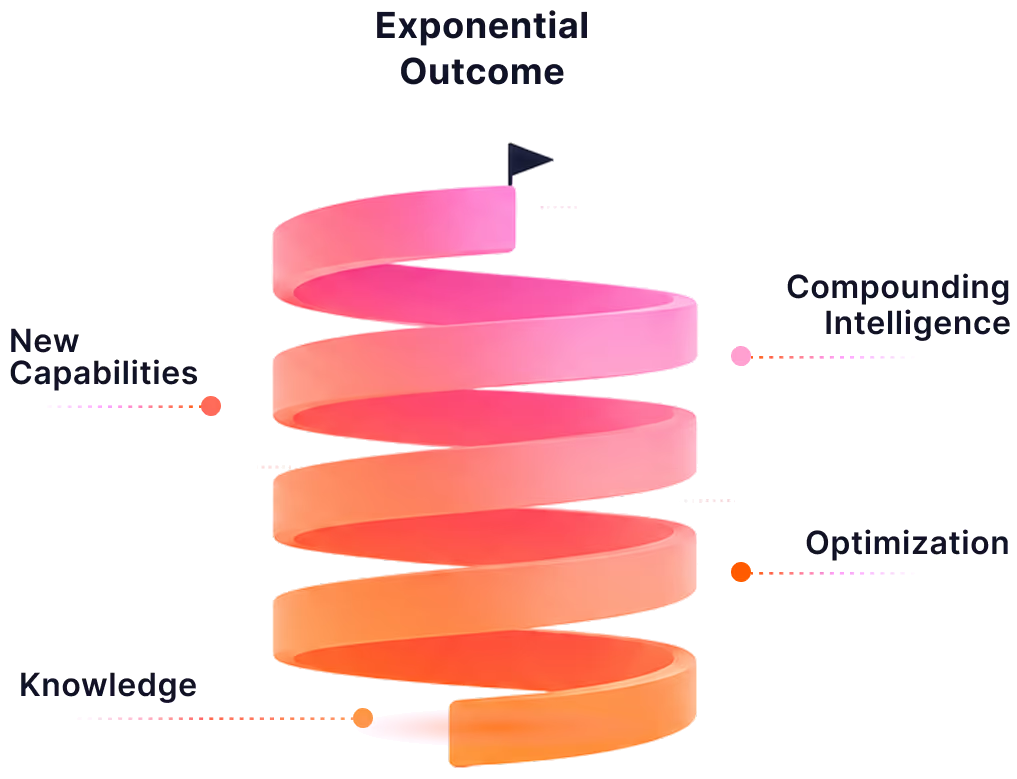
Upward spiral from knowledge to exponential outcomes through optimization, new capabilities, and compounding intelligence

The matching logic is extended to further entities, accounts, and currencies using the mapping rules already defined for the group.

Reconciliation pairs with spend analysis, since payables detail and supplier records draw on the same governed transaction data.

The reconciled ledger supports profit and earnings modeling, so margin analysis is built on positions that have been matched and documented.

Exception patterns inform fraud detection, as recurring mismatches and unusual counterparties are identified from the same record of resolved items.

4-Step Process

How to Get Started

Every RapidCanvas solution is built using the same four-stage process. From the system of record to the moment of decision. Four stages, one engine.

1

Design

Describe your problem in plain language, and the platform turns it into working pipelines and models.

2

Connect

Access all your business data in place, wherever it lives, without moving or duplicating it.

3

Implement

Move from Design into your real environment and tools, with experts guiding every key decision.

4

Govern

Compliance and monitoring run alongside the work, not as a bottleneck at the end.

See it on your own ledger and bank data.

Bring a general ledger extract and the matching bank feed for one reconciliation. We will show you the transactions matched, the residuals classified by root cause, and the exception report prepared for audit, and tell you whether the data you already hold supports a working solution.

Book a discovery call

Got questions? We're here to answer them for you

Have more questions?
Contact our support team to get what you need.

It matches transactions across general ledger extracts, bank feeds, and sub-ledgers throughout the period, classifies unreconciled items by root cause, generates the journal entries required to clear matched items, and formats an exception report for external audit with supporting documentation attached.
Rule-based tools match items that satisfy a defined rule and return the remainder as a single queue. This solution matches by amount, date, and counterparty across differing identifiers, then classifies the remainder by root cause, so review is directed to the items that require a decision. Expert review is applied at the exception layer, and resolved exceptions inform later matching.
Core inputs are general ledger and sub-ledger detail, bank and treasury feeds, transaction source systems, supporting documentation, and entity and account structures. The solution can begin with a single reconciliation, such as the intercompany accounts or the bank-to-ledger match, and be extended as further sources are connected.
Transactions are matched by amount, date, and counterparty, in addition to any shared identifier. Matching logic is built on the chart of accounts and identifier conventions of the organization, and formats are normalized before comparison so that the same transaction is recognized across sources.
Each residual item is assigned a root cause: timing, missing documentation, dispute, or system mismatch. Timing differences that resolve within the period are separated from items that require documentation or a decision, so reviewers work from the items that need judgment.
The solution generates the entries required to clear matched items and presents them ready to post, which removes manual keying. Posting authority and approval workflow remain with the organization and follow its existing controls.
Supporting documentation is attached to each exception when the decision is made, and the exception report is formatted for the external audit team. An audit request is therefore answered by retrieving the record, and not by assembling it after the fact.
Yes. The same matching logic is applied across intercompany accounts, legal entities, and currencies, governed by the mapping rules already defined for the group. Each entity retains its own mapping, and the results are presented in one comparable view.
It is designed for finance operations and controllership teams in professional services, construction, real estate, and wealth management, and for organizations with high-volume payables. The typical starting condition is a close cycle extended by manual reconciliation across systems that do not share identifiers.
The first step is a 30-minute discovery call. Bring the reconciliation that requires the most close capacity, and RapidCanvas will assess whether the ledger, bank, and sub-ledger data you already hold supports a working solution before any project scope is agreed.