RapidCanvas
USE CASE: CUSTOMER RETENTION

Analyze customer data and optimize retention metrics.

Built for consumer and business-to-business organizations with behavioral history in customer relationship management, e-commerce, and loyalty platforms, where retention decisions rely on aggregate metrics and the operating segments were set in a planning cycle that no longer matches the customer base.

The Retention Challenge

Unexpected customer churn is costly and unpredictable.

Behavioral data accumulates across transaction, engagement, and service systems, while the segments used to act on it were defined during annual planning from demographic or transactional criteria. No report measures the difference between those definitions and current behavior, so acquisition and retention spend continues against a profile the customer base no longer matches. Retention decisions are made from portfolio-level totals in which segment-level behavior is not reported, and by the time churn appears in the aggregate, the period for effective intervention has ended.

Customer retention / Where segmentation loses accuracy
Customer & Transaction Data
  1. Unanalyzed

    Behavioral Data Accumulates

    Customer behavior is recorded across transaction, engagement, and service systems, and no systematic analysis is applied to it.

  2. Fixed annually

    Segments Set Once

    Segments are defined during annual planning from demographic or transactional criteria and are rarely tested against current customer behavior.

  3. Unmeasured

    Definitions Diverge From Behavior

    Over the year, actual behavior departs from the segment definitions, and no report measures the difference.

  4. Misdirected

    Spend Follows an Outdated Profile

    Retention decisions are based on portfolio-level totals in which segment-level behavior is not reported, and acquisition and retention spend is applied to a profile the base no longer matches.

Next planning cycleReturns to step 1
Solution Capabilities

An integrated model for retention modeling and churn prediction.

Behavioral modeling provides the foundation, while disengagement signs are quickly escalated and matched with practical recommendations for retention.

Differentiates segments by customer disposition as well as purchase behavior, using survey, review, and satisfaction sources, so two cohorts that buy alike and hold different views are treated differently.
Identifies the behaviors most strongly associated with long-term customer value, which is often a different measure than the one the business currently optimizes.
Identifies cohorts with early signs of disengagement before churn is visible, within a named segment and not against the portfolio average.
Identifies which segments are gaining revenue share and which are losing it, and frequently establishes that the historic core segment is the one in decline.
Specifies messaging priorities, channel mix, and the retention or growth action for each segment, so the analysis is ready to execute.
Attaches an expected revenue impact and a tracking metric to every recommendation, so each action can be measured from the point it is deployed.
Customer Insights Advisor screen plotting the engagement index by month for four behavioral segments, with one cohort below its baseline and a recommended retention action
Our Solutions Always Employ

The Hybrid Approach™ to Enterprise AI

Human-led, agent-executed, and context-driven by design.

RapidCanvas is the only partner with a Hybrid Approach™ that closes the execution gap between AI potential and real enterprise results by delivering solutions that are outcome-first, context-driven, and expert-optimized.

Agentic automation, custom data apps, access, security, and governance
Enterprise-Grade ArchitectureAgentic Automation | Custom Data Apps | Access | Security | Governance
+
Industry experts, AI engineers, customer success, and cloud-ops
Human ExpertiseIndustry Experts | AI Engineers | Customer Success | Cloud-Ops
Customer Benefits

Retention risks are measurable and recommendations are actionable.

Market to the Base as It Is Now

Segments reflect current behavior across the active customer base and not a definition set in a previous planning cycle.

Act Before Disengagement Becomes Churn

Early behavioral indicators are reported within a named segment, while intervention is still effective.

Convert Segmentation Into Programs

Each segment includes a recommended engagement strategy, so the output is a program and not a report that requires further interpretation.

Direct Spend to the Highest Return

Revenue trajectory and quantified impact by segment inform allocation across acquisition and retention.

Maintain One Foundation

A single segmentation supports acquisition, retention, and personalization, in place of three separate views of the same customer base.

Expansion Planning

Compounding IntelligenceEach solution makes the next one smarter.

RapidCanvas delivers retention and segmentation in the context of the surrounding customer and revenue intelligence use cases, with the customer and signal model shared across each.
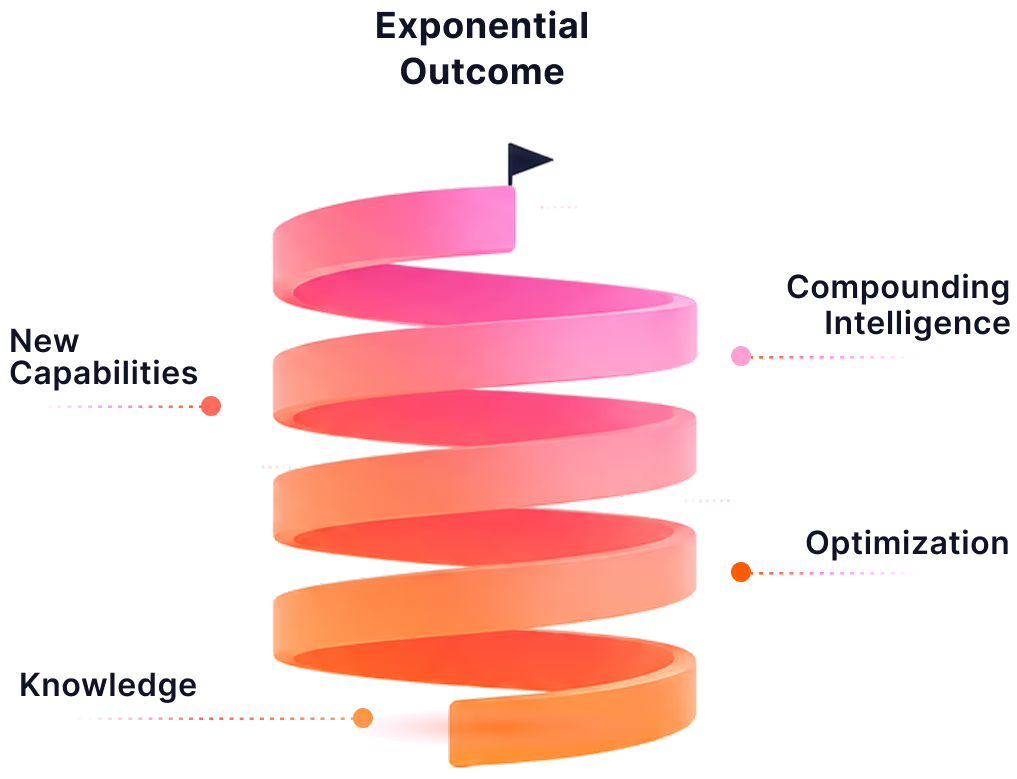
Upward spiral from knowledge to exponential outcomes through optimization, new capabilities, and compounding intelligence

Segment definitions are recalculated as transaction, engagement, and service data arrive, so they remain current between planning cycles.

Segmentation pairs with revenue and pipeline growth, since account scoring and customer segmentation draw on the same governed customer and signal model.

Voice-of-customer analysis extends the attitudinal layer, adding sentiment from calls, surveys, and reviews to the behavior already recorded.

Segment economics inform quote generation and pricing, so offers reflect the lifetime value and retention risk of each customer group.

4-Step Process

How to Get Started

Every RapidCanvas solution is built using the same four-stage process. From the system of record to the moment of decision. Four stages, one engine.

1

Design

Describe your problem in plain language, and the platform turns it into working pipelines and models.

2

Connect

Access all your business data in place, wherever it lives, without moving or duplicating it.

3

Implement

Move from Design into your real environment and tools, with experts guiding every key decision.

4

Govern

Compliance and monitoring run alongside the work, not as a bottleneck at the end.

See it on your own customer base.

Bring a customer export with transaction history and the segments you use today. We will show you the segments current behavior supports, the cohorts at risk of churn, and the action attached to each, and tell you whether the data you already hold supports a working solution.

Book a discovery call

Got questions? We're here to answer them for you

Have more questions?
Contact our support team to get what you need.

It groups the customer base into segments defined by current transaction, engagement, and service behavior, and profiles each segment by lifetime value, average order value, and revenue trajectory. Cohorts showing early signs of disengagement are identified within each segment, and every segment is assigned a recommended retention or growth action with an expected revenue impact and a metric to track.
Most operating segments are defined once, during annual planning, from demographic or transactional criteria, and are then applied unchanged for the year. This solution builds segments from behavior in the current data and recalculates them as that behavior changes. Each segment also includes its economic value and a recommended action, which a static segment definition does not provide.
Core inputs are transaction history, customer relationship management records, engagement and marketing platform data, and support and service records. Survey, review, and satisfaction data add an attitudinal view, and financial records supply margin and acquisition cost. Segmentation can begin with a subset of these sources and be extended as further sources are connected.
The model measures each customer's engagement and transaction behavior against the baseline of its own segment, using indicators such as purchase recency, purchase frequency, and change in category mix. A cohort that departs from its segment baseline is identified before the loss appears in portfolio-level retention figures, and a retention action is attached to each flagged cohort.
Behavioral segments are defined by what customers do, such as purchase frequency, order value, category mix, and recency. Attitudinal segments add what customers report, drawn from survey, review, and satisfaction data. Combining the two separates customers who buy in the same way but hold different views of the relationship, and those groups need different engagement.
Each segment is profiled by lifetime value, average order value, and revenue trajectory, using transaction and financial records. The profile identifies which segments are gaining revenue share and which are losing it, so acquisition and retention spend can be allocated on value and not on segment size.
Each segment receives a profile of its defining characteristics and economic value, a recommended engagement strategy covering messaging priorities and channel mix, an expected revenue impact, and the metrics to track. Marketing and customer success teams work from the same output.
Segment assignments and definitions are recalculated as new transaction, engagement, and service data arrive. The segmentation therefore reflects present behavior between planning cycles, and changes in a segment's size, value, or trajectory are reported when they occur.
It is designed for marketing, customer success, and revenue teams in consumer and business-to-business organizations that hold behavioral history in customer relationship management, e-commerce, and loyalty platforms. The typical starting condition is a customer base marketed to as a single audience, or segments that have not been reviewed since they were first defined.
The first step is a 30-minute discovery call. Bring the retention and segmentation questions that matter most, and RapidCanvas will assess whether the transaction, engagement, and service data you already hold supports a working solution before any project scope is agreed.