RapidCanvas
USE CASE: FRAUD DETECTION

Prevent fraud and boost financial returns with the team you have today.

Built for fraud operations, risk, and data science teams at payment providers and financial institutions, and where analysts assess fraud exposure with account-specific investigations and manage prevention rules with manual processes or outdated systems.

The Fraud Analysis Challenge

Fraud prevention requires consistent policy and model updates to match the pace of change.

Producing a fraud prevention recommendation for a single merchant or account requires a data scientist to work through that account's transaction history, which takes hours and reaches only a subset of the available record. Analysis capacity is therefore set by headcount, recommendations arrive weeks after they are requested, and the resulting rule set reflects the last scheme reviewed and not the behavior in the portfolio today.

Fraud detection / Where fraud analysis falls behind
Transaction History
  1. Capacity-limited

    Analysis Is Performed by Hand

    Each account requires hours of investigation by a data scientist before a recommendation can be made, so the number of accounts served is fixed by the size of the team.

  2. Partial

    Review Reaches a Subset of the Record

    Hand analysis examines a fraction of the available history, so patterns that span channels or longer time windows remain undetected.

  3. Delayed

    Recommendations Arrive Weeks Late

    An account that waits 2 weeks for a fraud protection recommendation is exposed for the whole of that period, and the delay reduces confidence in the service that produced it.

  4. Retrospective

    Rule Sets Reflect the Last Review

    Prevention rules are rewritten by hand after each new scheme, so the rule set describes the fraud behavior of the last review and not the behavior in the portfolio today.

Next new schemeReturns to step 1
Solution Capabilities

Fraud pattern detection, dynamic rule mapping, and recommendations designed to fit your business.

Detection across the full transaction history establishes the solution core, and supporting capabilities include pattern matching, anomaly detection, and rule recommendations, as well as end-user dashboards and notifications to accelerate action on high priority items with the most significant business impact.

Ingests transaction, account, and confirmed-outcome data from multiple sources into one view of every account, with no manual data gathering ahead of the analysis.
Detects fraud patterns and anomalies across the full transaction history, including behavior that a manual review of a data subset does not reach.
Creates and updates prevention rules from current findings, so the deployed rule set follows fraud behavior as it changes.
Produces a rule set specific to each merchant or account, with the reasoning behind every recommendation written for a non-technical reader.
Presents fraud trends and recommended actions to account, risk, and commercial teams, which allows them to act without waiting for data science interpretation.
Tracks false positive volume and detection accuracy against confirmed outcomes, so each rule change is evaluated on evidence.
Fraud Risk Analyst screen showing merchant accounts connected by shared attributes, with a flagged cluster of 7 accounts and pattern strength scored against threshold
Our Solutions Always Employ

The Hybrid Approach™ to Enterprise AI

Human-led, agent-executed, and context-driven by design.

RapidCanvas is the only partner with a Hybrid Approach™ that closes the execution gap between AI potential and real enterprise results by delivering solutions that are outcome-first, context-driven, and expert-optimized.

Agentic automation, custom data apps, access, security, and governance
Enterprise-Grade ArchitectureAgentic Automation | Custom Data Apps | Access | Security | Governance
+
Industry experts, AI engineers, customer success, and cloud-ops
Human ExpertiseIndustry Experts | AI Engineers | Customer Success | Cloud-Ops
Customer Benefits

Fraud analysis with enterprise scale and rapid results.

Scale Analysis Without Adding Headcount

The number of accounts analyzed grows with the portfolio and is no longer bounded by the size of the data science team.

Compress the Analysis Cycle

Per-account investigation moves from hours to minutes, so a recommendation reaches the account while the exposure it addresses is current.

Improve Detection Quality

Pattern detection across the full history lowers false positive volume and raises detection accuracy, measured against confirmed outcomes.

Place Findings With the Account Team

Dashboards and written reasoning allow account, risk, and commercial teams to act without routing each question through data science.

Expansion Planning

Compounding IntelligenceEach solution makes the next one smarter.

RapidCanvas delivers fraud detection in the context of the surrounding finance and risk use cases, with the transaction and account data shared across each.
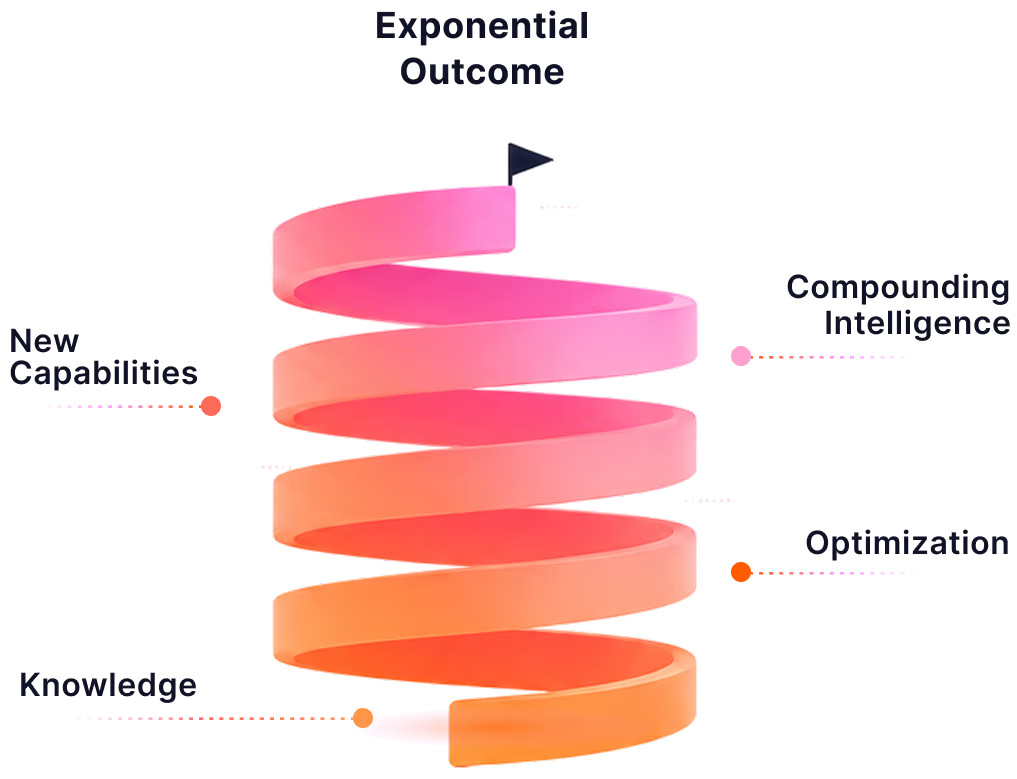
Upward spiral from knowledge to exponential outcomes through optimization, new capabilities, and compounding intelligence

The rule set is updated as new findings are confirmed, so prevention keeps pace with fraud behavior between formal reviews.

Fraud detection pairs with accounting and reconciliation, since both rely on the same governed transaction and sub-ledger records.

Fraud findings inform spend analysis, where payment and supplier data are examined for irregular activity alongside cost.

Customer retention and segmentation draw on the same account data, so risk and relationship decisions rest on one view of the account.

4-Step Process

How to Get Started

Every RapidCanvas solution is built using the same four-stage process. From the system of record to the moment of decision. Four stages, one engine.

1

Design

Describe your problem in plain language, and the platform turns it into working pipelines and models.

2

Connect

Access all your business data in place, wherever it lives, without moving or duplicating it.

3

Implement

Move from Design into your real environment and tools, with experts guiding every key decision.

4

Govern

Compliance and monitoring run alongside the work, not as a bottleneck at the end.

See it on your own transaction history.

Bring the transaction history and confirmed fraud outcomes for one merchant or account. We will show you the patterns that a manual review does not reach, the prevention rules generated with their reasoning, and whether the data you already hold supports a working solution.

Book a discovery call

Got questions? We're here to answer them for you

Have more questions?
Contact our support team to get what you need.

It analyzes the transaction history of each merchant or account, detects fraud patterns and anomalies across the full record, and generates a prevention rule set tailored to that account. Every recommendation is accompanied by written reasoning for the person who has to act on it.
A rules engine applies the rules it has been given, and those rules are written by hand after a scheme has been reviewed. This solution analyzes the full history to find the patterns present in the portfolio and generates rules from those findings, which are updated as new outcomes are confirmed. It supplies the analysis and the recommendation, and the deployed rules engine remains in place.
Manual analysis is limited by the hours a data scientist can spend on each account and reaches a subset of the available history. This solution processes the full record for every account, so analysis capacity grows with the portfolio. Data scientists retain oversight of the models and the rules that are generated.
Core inputs are transaction processing systems, customer and account master data, and case management and loss history that record confirmed outcomes. Behavioral and device signals and external risk sources can be added. The solution can begin with a subset of these sources, typically transaction history and confirmed fraud cases, and be extended as further sources are connected.
Rules are created from the patterns and anomalies detected in the account's own transaction history and confirmed fraud outcomes. Each rule is presented with the behavior that supports it and an estimate of the fraud loss it would have prevented, so the team can approve, adjust, or decline it before deployment.
False positive volume and detection accuracy are tracked against confirmed outcomes. A change to a rule is therefore evaluated on the evidence in the record and not on expectation. At a Fortune 200 payment provider, false positive flags fell by 15 percent and detection accuracy improved by more than 10 percent.
Yes. Each recommendation carries the reasoning behind it, written for a non-technical reader, so account, risk, and commercial teams can review it and hold the conversation with the merchant without technical support.
A Fortune 200 payment provider reduced analysis time per investigation by 96 percent, from 4 hours to under 5 minutes, and reduced fraud analysis costs by $800K. Merchant analysis capacity rose from 550 to more than 2,000 annually with no added headcount, and data scientist workload fell by 40 percent.
It is designed for fraud operations, risk, and data science teams at payment providers and financial institutions that analyze fraud exposure account by account. The typical starting condition is a portfolio of merchants or accounts in which each rule recommendation requires hours of manual analysis.
The first step is a 30-minute discovery call. Bring the fraud analysis questions that matter most, and RapidCanvas will assess whether the transaction and outcome data you already hold supports a working solution before any project scope is agreed.