RapidCanvas
USE CASE: PRICING OPTIMIZATION

Establish pricing policies aligned with market needs and profit goals.

Built for sales and pricing leadership at manufacturers and distributors that sell through both a distribution channel and a direct sales force across multiple regions, where discount authority is distributed across the field and the reason for a concession is not recorded.

The Pricing Challenge

Price concessions lack data-driven evidence and traceability to business drivers.

Pricing managers often have limited visibility to account-specific context and the most current inputs. Data silos prevent comparable policy comparisons, and discounts are approved without documented reason codes or customer volume commitments. Margin erosion accumulates across thousands of individual decisions and hits the bottom line before management can deploy corrective action.

Pricing optimization / Where pricing discipline is lost
Quotes & Transactions
  1. Manual

    Pricing Context Is Assembled by Hand

    Purchase history, prior quotes, book price, and volume tiers are gathered from separate systems before a price is proposed, and large parts of the catalog carry no list price.

  2. Siloed

    Visibility Ends at the Territory Line

    Comparable transactions in other regions are unavailable when the price is set, so each region prices the same part without reference to the others.

  3. Unrecorded

    Discounts Are Approved Without a Reason

    A concession is granted with no reason code and no volume commitment attached, which leaves no record to review and no pattern to analyze.

  4. Untested

    Standing Quotes Renew Without a Consumption Test

    A quote renews on its calendar interval whether or not purchased volume matched the commitment that justified the discount, so the concession continues after its rationale has ended.

Next quoteReturns to step 1
Solution Capabilities

Pricing aligned with recommended min-max tiers, and a permanent record of every policy decision.

Optimal price ranges set the foundation, paired with context-rich pricing logic, regional sensitivity, traceable business rules, and full auditability.

Returns a floor, a recommended price, and a ceiling for the part and account in question, then evaluates the price a representative proposes against that band while the number is still open to change.
Classifies each part as differentiated, selective, or commodity with a confidence score, which establishes how much discretion the price deserves.
Consolidates distribution and direct purchase history, prior and open quotes, book price history, volume tiers, and verified competitive cross references into one view. Request for quote intake from a pasted message, document, or image pre-fills the quote for review.
Evaluates each quote against the scale that governs its market, so a price appropriate in one region is not applied as precedent in another.
Permits full discretion where pricing power is demonstrable, requires a reason code where it is thin, and applies book price to commodity parts beneath the consumption threshold. Deterministic rules can be extended by commercial leadership.
Assigns a unique, immutable identifier to every quote decision, override, reason code, and approval, filterable by region, distributor, part, reason code, representative, and period.
Price Optimizer screen showing a proposed price plotted beneath the floor of the recommended band, with margin at risk, gap to band floor, pricing power, and a recommendation to bring the quote to the band floor before release
Our Solutions Always Employ

The Hybrid Approach™ to Enterprise AI

Human-led, agent-executed, and context-driven by design.

RapidCanvas is the only partner with a Hybrid Approach™ that closes the execution gap between AI potential and real enterprise results by delivering solutions that are outcome-first, context-driven, and expert-optimized.

Agentic automation, custom data apps, access, security, and governance
Enterprise-Grade ArchitectureAgentic Automation | Custom Data Apps | Access | Security | Governance
+
Industry experts, AI engineers, customer success, and cloud-ops
Human ExpertiseIndustry Experts | AI Engineers | Customer Success | Cloud-Ops
Customer Benefits

Pricing policy is aligned with business objectives and market expectations.

Record a Reason on Every Concession

Each quote priced beneath the band carries a reason code and an approval trail, so discounting becomes a reviewable practice.

Clear Routine Quotes Without a Human Decision

Commodity parts beneath the consumption threshold are quoted at book price automatically, which returns representative capacity to the quotes where judgment changes the outcome.

Defend Price Where the Product Earns It

Pricing power classification identifies the parts on which a premium is defensible, so discretion is concentrated on the products that reward it.

Make the Pricing Record Reviewable

A permanent identifier on every decision, override, and approval makes concession patterns filterable by region, distributor, part, and representative.

Expansion Planning

Compounding IntelligenceEach solution makes the next one smarter.

RapidCanvas delivers pricing optimization in the context of the surrounding quoting and revenue use cases, with the transaction and account data shared across each.
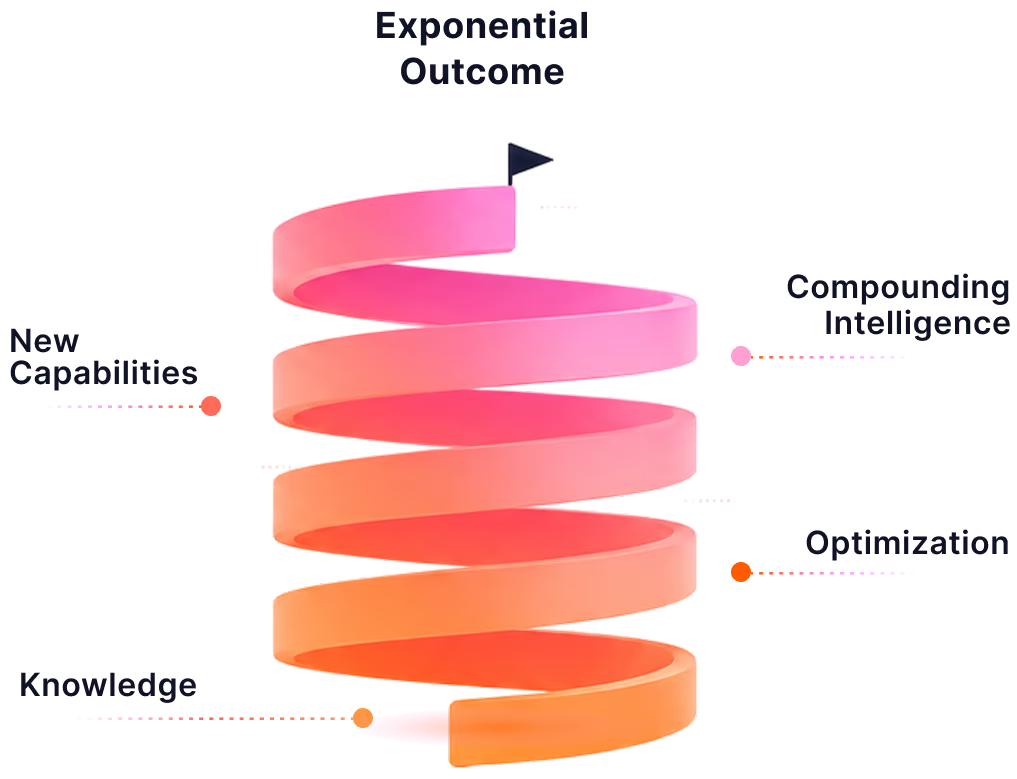
Upward spiral from knowledge to exponential outcomes through optimization, new capabilities, and compounding intelligence

Each reason code, override, and consumption event is added to the decision log, so the pricing power classification is refined with every quote cycle.

Pricing optimization pairs with quote generation, since a sized and configured quote is evaluated against the band before it is released.

Pricing optimization pairs with revenue and pipeline growth, since account prioritization and price governance use the same governed transaction history.

Price bands extend to additional business units and regions as the transaction record for each is connected.

4-Step Process

How to Get Started

Every RapidCanvas solution is built using the same four-stage process. From the system of record to the moment of decision. Four stages, one engine.

1

Design

Describe your problem in plain language, and the platform turns it into working pipelines and models.

2

Connect

Access all your business data in place, wherever it lives, without moving or duplicating it.

3

Implement

Move from Design into your real environment and tools, with experts guiding every key decision.

4

Govern

Compliance and monitoring run alongside the work, not as a bottleneck at the end.

See it on your own quotes.

Bring a sample of recent quotes with the prices offered and the discounts granted. We will show the recommended band for each part and account and the position of each price against it, and tell you whether the transaction, book price, and quote data you already hold supports a working solution.

Book a discovery call

Got questions? We're here to answer them for you

Have more questions?
Contact our support team to get what you need.

It builds a recommended price band of floor, target, and ceiling for each part and account from the transaction history of the business, evaluates the price a representative proposes against that band at the point of quote, and records a reason code and approval wherever a price falls beneath the band. Every quote decision is written to a permanent log.
A price list and an approval matrix apply fixed rules that do not reflect what comparable customers have paid. This solution derives the band from realized transactions on the regional scale that governs the buyer, and it classifies the pricing power of each part, so the discretion granted to a representative corresponds to the evidence for that part.
Core inputs are distribution and direct transaction history, book prices and increase history, prior and open quotes, volume tier and commitment terms, and verified competitive cross references. The solution can begin with a subset of these sources, typically transaction history and book price, and be extended as further sources are connected.
The band is calculated from the customer's own transactions for comparable parts and accounts, resolved at the customer group and marketing part level so that it reflects the full commercial relationship. The floor, recommended price, and ceiling are returned together with the comparable volume on which they rest.
Each part is classified as differentiated, selective, or commodity, with a confidence score. The classification determines the enforcement tier: full discretion where a premium is demonstrable, a required reason code and volume commitment where pricing power is thin, and book price on commodity parts beneath the consumption threshold.
Each quote is evaluated against the price scale that governs its market. A price that is appropriate in one region is therefore not applied as precedent in another, and a proposed price is compared with the transactions that are relevant to the buyer.
Yes. Pricing and commercial specialists define the pricing power classification, the regional scales, and the thresholds that separate advisory guidance from an enforced price. Deterministic condition-to-outcome rules, including design registration conflicts and low volume order handling, can be extended by commercial leadership without a new engagement.
A representative can paste a message, upload a document, or attach an image. The solution pre-fills the customer, part, quantity, and region with a confidence indicator, and a review step precedes any commitment.
Every quote decision, override, reason code, approval, and consumption event receives a unique, immutable identifier. The log can be filtered by business unit, region, distributor, part, reason code, representative, and period, which allows concession patterns to be reviewed directly.
The first step is a 30-minute discovery call. Bring a sample of recent quotes, and RapidCanvas will assess whether the transaction, book price, and quote data you already hold supports a working solution before any project scope is agreed.