


Quantify service level and working capital impact before committing to a plan.


Planning models struggle to match the pace of business decisions.
Planning organizations commit to a single forecast and discover the cost of being wrong only after inventory has already been positioned. When a supplier lead time extends, a promotion overperforms, a major customer project slips a quarter, or a tariff changes landed cost, planners rebuild the plan by hand in spreadsheets, one variable at a time, with no consistent method for propagating the change through safety stock, reorder points, and replenishment timing.
- One forecast
A Single Committed Plan
The organization commits to one forecast, and the cost of error becomes visible only after inventory is positioned against it.
- Manual rebuild
Plans Rebuilt Variable by Variable
A supplier lead-time extension or a promotion overperformance returns planners to spreadsheets, with no consistent method for propagating the change through safety stock, reorder points, and replenishment timing.
- Too late
Analysis Arrives After the Decision
Quantifying the service-level and working-capital effect of demand running below plan takes days, which places the answer beyond the decision window.
- Unpriced risk
Exposure Escalates Only Once Visible
Trade-off decisions carrying material working-capital exposure are made on planner judgment and escalate only after the exposure appears in finished inventory or missed orders.
Trust your supply chain plan before committing.
Quantified scenarios are the core, but the surrounding capabilities decide whether a planner's judgment survives the run or gets applied by hand afterward.

The Hybrid Approach™ to Enterprise AI
Human-led, agent-executed, and context-driven by design.
RapidCanvas is the only partner with a Hybrid Approach™ that closes the execution gap between AI potential and real enterprise results by delivering solutions that are outcome-first, context-driven, and expert-optimized.


Build and implement plans with confidence and speed.
Decide Inside the Window
Move scenario analysis from days of spreadsheet rebuilding into the window where the answer still changes the decision.
Quantify Working Capital Exposure
Put a number on the cash tied up under each scenario, which raises the conversation from a supply-chain metric to a CFO metric.
Preserve Planner Judgment
Keep manual adjustments inside the model, propagating through safety stock, reorder points, and replenishment timing rather than diverging from the committed plan.
Commit With Trade-offs Visible
Give the VP Supply Chain a plan where the service-level and cash consequences of the alternatives were priced before the commitment.
Market-Proven and Scale-Ready.

Compounding IntelligenceEach solution makes the next one smarter.
Scenario Planning is rarely a standalone engagement: it runs on the governed model the earlier work already built, and planner judgment compounds inside it.
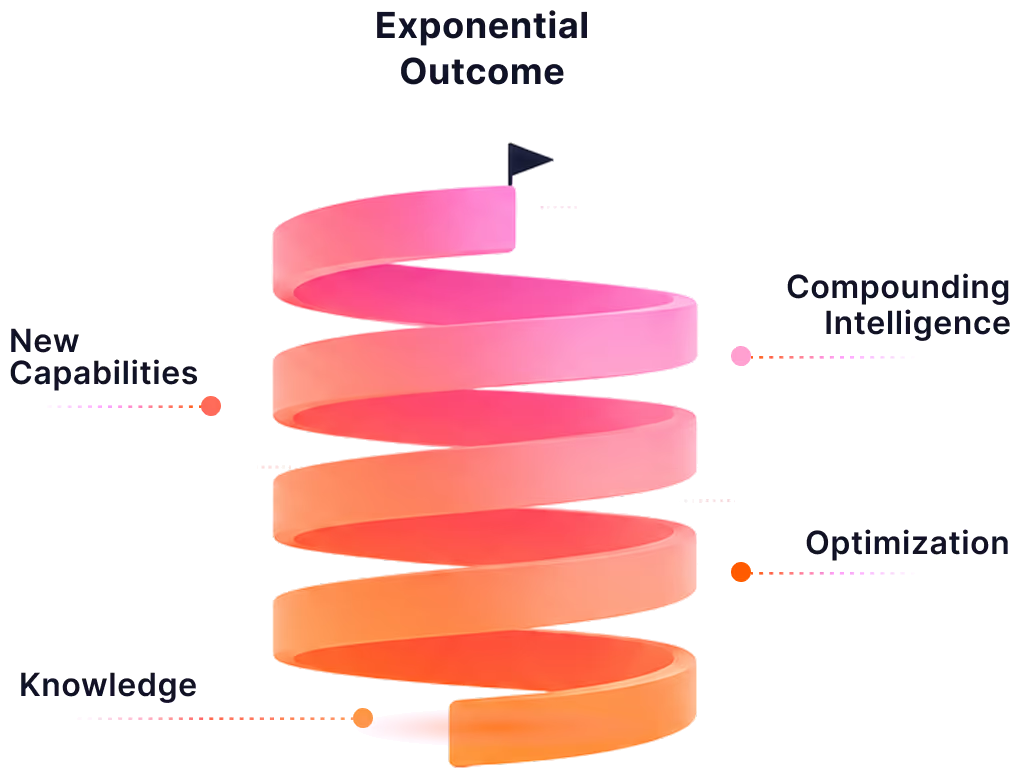
Scenario Planning runs on the governed demand model, inventory policy, and cost assumptions already established for you, so it extends the existing engagement rather than starting a new one.
It sits naturally on top of Demand Forecasting and Inventory Optimization: the same model that sets the plan is the one you interrogate before committing to it.
Planner adjustments persist inside the model and carry through to reorder points and replenishment timing, so each cycle's judgment compounds instead of being reapplied by hand.
New scenario types (supplier shifts, promotional lift, product transitions) extend the same governed model without a separate rebuild.
How to Get Started
Every RapidCanvas solution is built using the same four-stage process. From the system of record to the moment of decision. Four stages, one engine.
Design
Describe your problem in plain language, and the platform turns it into working pipelines and models.
Connect
Access all your business data in place, wherever it lives, without moving or duplicating it.
Launch
Move from Design into your real environment and tools, with experts guiding every key decision.
Govern
Compliance and monitoring run alongside the work, not as a bottleneck at the end.
See the trade-offs before you commit the plan.
Bring us the planning decision that cost you the most last cycle. We will model it as scenarios against your own demand history and policy, so the service-level and working-capital trade-offs are visible before you commit.
Book a discovery callGot questions? We're here to answer them for you
Have more questions?
Contact our support team to get what you need.


