RapidCanvas
USE CASE: SPEND ANALYSIS

Convert spend history into decisive negotiation leverage.

Built for finance and procurement teams in financial services, payments, and high-volume accounts-payable environments, where supplier and vendor spend is a critical input to profitability and overall financial results.

The Spend Challenge

Spend accumulates without benchmark context or history.

Most organizations hold detailed payables history, and the analytical layer that would relate it to the market is produced periodically. Savings opportunities are identified from static spend reports and fragmented enterprise resource planning extracts, and consultant-led category reviews arrive on a project cadence. Establishing a negotiating position requires supplier benchmarks calibrated to the categories and volumes the business purchases, so a supplier priced above market is often engaged without the evidence that would support a change.

Spend analysis / Where negotiating position is lost
Payables & Supplier Data
  1. Descriptive

    Spend Is Reported, Not Assessed

    Savings opportunities are drawn from static spend reports and fragmented enterprise resource planning extracts, which record what was spent and do not indicate where the rate is wrong.

  2. Periodic

    Reviews Follow a Project Calendar

    Consultant-led category reviews are delivered periodically and priced accordingly, which leaves most of the year outside any active review.

  3. Unreferenced

    Market Context Is Not Calibrated

    Supplier pricing is rarely compared with market comparables matched to the categories and volumes purchased, so a supplier priced above market is negotiated without supporting evidence.

  4. Manual

    Preparation and Timing Are Handled Separately

    Vendor history, current rate, and volume position are assembled by hand, typically 15 to 20 minutes per conversation, while renewal timing is tracked apart from spend performance.

Next renewal cycleReturns to step 1
Solution Capabilities

Procurement policies establish priority scoring and set clear negotiation targets.

Benchmarking establishes where a rate is above market, and the surrounding capabilities determine whether a negotiator opens the conversation with documented evidence and sufficient contract runway to act on it.

Compares unit costs with available market comparables by spend category, normalized across supplier naming, category coding, and entity structure.
Identifies suppliers priced materially above benchmark and ranks them by addressable savings, so effort is applied to the largest recoverable gaps.
Reports renewal timing against each target, so a renegotiation begins while sufficient contract runway remains.
Assembles vendor history, current rate, and volume position for each supplier, with a market-calibrated reference and supporting talking points attached.
Scores the order in which conversations should be opened, so negotiator time follows addressable value and not the sequence of renewal dates.
Ranks underserved markets in which demand exists and supplier coverage is absent, which directs sourcing toward defined targets.
Cost and Spend Advisor screen showing unit cost against the market benchmark range for four categories, with cloud infrastructure priced 18 percent above market and a recommendation to open renegotiation ahead of auto-renewal
Our Solutions Always Employ

The Hybrid Approach™ to Enterprise AI

Human-led, agent-executed, and context-driven by design.

RapidCanvas is the only partner with a Hybrid Approach™ that closes the execution gap between AI potential and real enterprise results by delivering solutions that are outcome-first, context-driven, and expert-optimized.

Agentic automation, custom data apps, access, security, and governance
Enterprise-Grade ArchitectureAgentic Automation | Custom Data Apps | Access | Security | Governance
+
Industry experts, AI engineers, customer success, and cloud-ops
Human ExpertiseIndustry Experts | AI Engineers | Customer Success | Cloud-Ops
Customer Benefits

Supplier spend is benchmarked, ranked, and timed to renewal.

Strengthen the Negotiating Position

Spend history becomes a set of proactive negotiation targets, each supported by the benchmark evidence that makes the request defensible.

Act Ahead of Renewal

Renegotiation opportunities are identified before contracts renew, while remaining runway still supports a position.

Prepare Every Vendor Conversation

Negotiators enter each discussion with a decision-ready package, in place of 15 to 20 minutes of manual assembly beforehand.

Identify Unserved Demand

Markets that supplier coverage has not yet reached become visible and ranked, which supports a targeted sourcing approach.

Expansion Planning

Compounding IntelligenceEach solution makes the next one smarter.

RapidCanvas delivers spend analysis in the context of the surrounding finance and planning use cases, with the supplier and contract data shared across each.
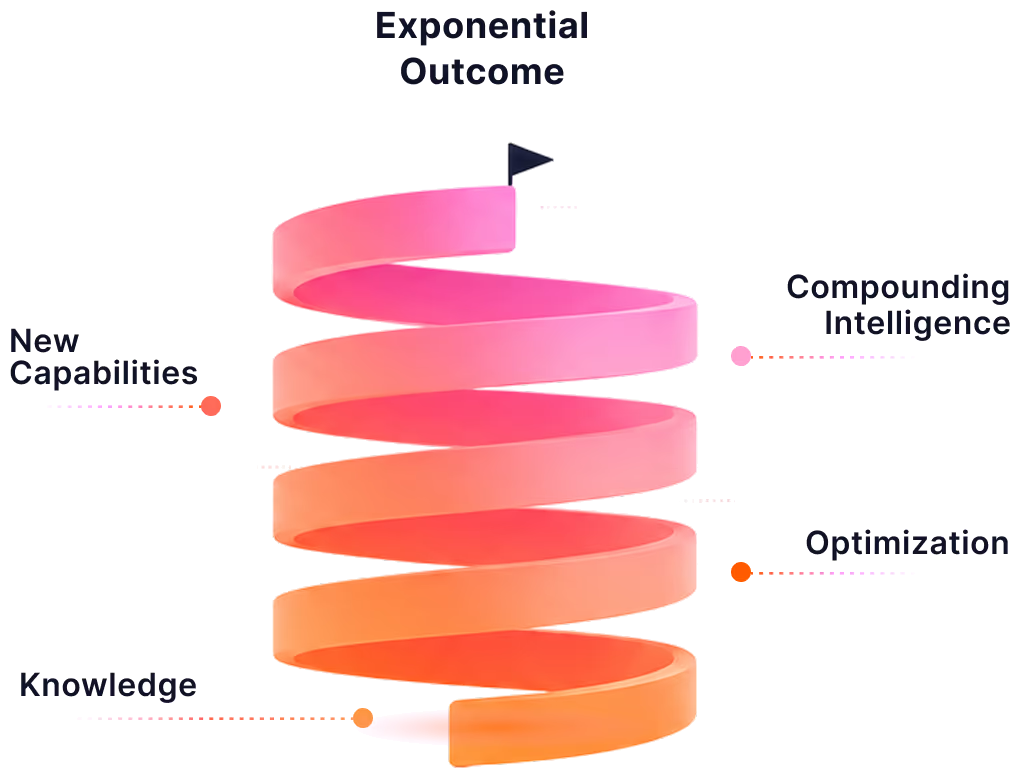
Upward spiral from knowledge to exponential outcomes through optimization, new capabilities, and compounding intelligence

The benchmark view is refreshed as payables data arrive, so target rankings remain current between category reviews.

Spend analysis pairs with profit and earnings modeling, since realized supplier savings enter the same cost structure that margin models draw on.

Contract and supplier records established for negotiation preparation extend to sourcing evaluation for suppliers not yet under contract.

Scenario planning applies negotiated rates to forward cost assumptions, so budgets reflect the outcome of each renewal.

4-Step Process

How to Get Started

Every RapidCanvas solution is built using the same four-stage process. From the system of record to the moment of decision. Four stages, one engine.

1

Design

Describe your problem in plain language, and the platform turns it into working pipelines and models.

2

Connect

Access all your business data in place, wherever it lives, without moving or duplicating it.

3

Implement

Move from Design into your real environment and tools, with experts guiding every key decision.

4

Govern

Compliance and monitoring run alongside the work, not as a bottleneck at the end.

See it on your own supplier spend.

Bring an extract of your recent accounts payable history. We will show you the categories benchmarked against the market, the suppliers ranked by addressable savings, and the contract timing for each, and tell you whether the data you already hold supports a working solution.

Book a discovery call

Got questions? We're here to answer them for you

Have more questions?
Contact our support team to get what you need.

It normalizes the accounts payable history of the organization, benchmarks unit costs against available market comparables, and identifies suppliers priced materially above benchmark. Targets are ranked by addressable savings and aligned to contract renewal timing, and a pre-negotiation package is prepared for each supplier.
Spend reports describe what was paid and require manual analysis to indicate where a rate is high. This solution compares each category and supplier with a market reference and returns a ranked set of targets with the estimated savings range and supporting data points for each.
A category review is delivered on a project calendar, and its findings age between engagements. This solution is built on the organization's own payables history and contract terms and is refreshed as data arrive, so the analysis is available throughout the year, including ahead of each renewal.
Core inputs are accounts payable and general ledger data, procurement and sourcing systems, contract repositories, and supplier performance records. External market benchmarks provide the comparison for unit cost. The solution can begin with a subset of these sources, typically 12 to 18 months of payables transactions, and be extended as further sources are connected.
Supplier names, category codes, and entity structures are normalized before any comparison is made, so that spend held under variant names or codes is consolidated. Unit costs are then compared with market comparables that correspond to the category and volume actually purchased.
Suppliers priced above a defined threshold relative to benchmark are ranked by addressable savings. Contract renewal timing and volume position are attached to each target, and a priority score indicates the order in which conversations should be opened.
Each package presents the vendor history, the current rate, the volume position, and a market-calibrated benchmark, together with the estimated savings range, the renewal timing, and the specific data points the procurement team should bring to the discussion. Every figure traces to its source record.
Yes. The same foundation supports sourcing evaluation, including assessment of inbound proposals against market comparables and a ranked view of underserved markets where demand exists and supplier coverage does not.
It is designed for finance and procurement teams in financial services, payments, and other organizations with high-volume accounts-payable environments. The typical starting condition is supplier spend that is reported in detail, with renegotiation prepared manually and timed to whichever renewal arrives next.
The first step is a 30-minute discovery call. Bring the categories and suppliers that matter most, and RapidCanvas will assess whether the payables, contract, and supplier data you already hold supports a working solution before any project scope is agreed.