


Turn a stale safety stock table into an actionable reorder policy for every SKU.


Working capital sits still while demand keeps moving.
Most organizations set safety stock and reorder parameters manually, calibrate them infrequently, and lack the analytical infrastructure to respond to SKU proliferation, supplier lead-time shifts, or demand-pattern changes without a full planning-cycle reset. The result is simultaneous overstock in slow movers and stockout risk in high-velocity SKUs: a working capital and service-level problem that compounds as product portfolios grow.
- Benchmarked
Benchmarks Substitute for Actual Data
Industry multiples and standard safety-stock rules replace the demand history, supplier lead times, and carrying cost of the specific business.
- Manual
Parameters Set Manually and Infrequently
Safety stock and reorder points are calculated by hand and recalibrated on a long cycle, so current policy governs a portfolio the business no longer holds.
- Outpaced
Portfolio Growth Outpaces Recalibration
New SKUs enter the catalog faster than parameters are recalculated, and policy coverage decays between planning cycles.
- Imbalanced
Overstocks and Stockouts
Slow movers hold excess capital while high-velocity items fall below coverage, and both conditions exist in the same catalog at the same time.
The Hybrid Approach™ to Enterprise AI
Human-led, agent-executed, and context-driven by design.
RapidCanvas is the only partner with a Hybrid Approach™ that closes the execution gap between AI potential and real enterprise results by delivering solutions that are outcome-first, context-driven, and expert-optimized.


An Outcome-led Solution Approach to Data-Driven Insights
RapidCanvas optimizes inventory policy at the individual SKU level using the customer's actual demand history, supplier lead times, and carrying cost parameters rather than industry benchmarks or rule-of-thumb safety stock multiples. The output is an actionable reorder policy rather than a dashboard, which means the planning team can implement recommendations without a separate analytical translation step. That execution proximity is the differentiator against BI-based inventory visibility tools.

Set inventory levels with real-world data and actionable plans.
SKU-level policy optimization forms the core, but the surrounding capabilities quantify the working capital in play, rank where the exposure sits, and turn the numbers into a replenishment policy the team can deploy.

Measurable Outcomes of Success.
Release Working Capital
Free cash currently held in oversized positions, quantified across the full portfolio rather than estimated on the slow movers alone.
Protect Service Levels
Reduce the position without increasing stockout risk, because coverage is calculated per SKU against actual lead times and volatility.
Scale Across Portfolio Growth
Maintain policy integrity through SKU proliferation, with parameters that recalculate rather than waiting for the next planning cycle.
Target the Highest Risk First
Rank the SKUs where current policy creates the most exposure, so the planning team works the list that moves the number.
Compounding IntelligenceEach solution makes the next one smarter.
Inventory Optimization rarely stays a standalone engagement, and the policy stays current the longer it runs.
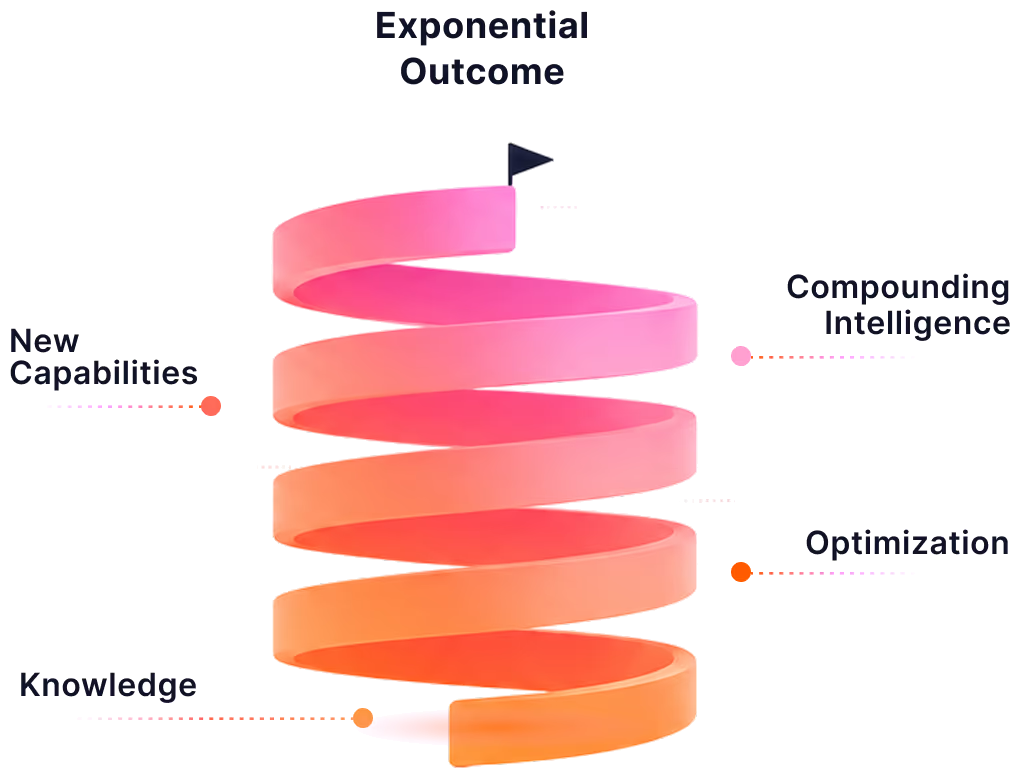
Policy stays current as the catalog grows: parameters recalculate through SKU proliferation instead of decaying until the next planning cycle resets them.
It pairs naturally with Demand Forecasting, since optimal safety stock and reorder points are calculated against the same governed demand model.
From there, Scenario Planning prices the cost of being wrong, testing lead-time shifts and demand swings against the same policy before inventory is committed.
Risk-concentration ranking directs effort to the SKUs that move the number, so each cycle compounds on the last rather than starting over.
How to Get Started
Every RapidCanvas solution is built using the same four-stage process. From the system of record to the moment of decision. Four stages, one engine.
Design
Describe your problem in plain language, and the platform turns it into working pipelines and models.
Connect
Access all your business data in place, wherever it lives, without moving or duplicating it.
Implement
Move from Design into your real environment and tools, with experts guiding every key decision.
Govern
Compliance and monitoring run alongside the work, not as a bottleneck at the end.
See it on your own SKU portfolio.
Bring us the on-hand positions and 12-month demand history for the portfolio that gives you the most trouble. We will show you the safety stock and reorder points calculated per SKU, and the working capital you could free by right-sizing positions across the catalog.
Book a discovery callGot questions? We're here to answer them for you
Have more questions?
Contact our support team to get what you need.


