


Optimize routing across the full logistics and transportation network.


Systems limited to movement tracking lack full network scope.
Logistics teams often manage routes and shipments piece by piece, with poor visibility into network cost and effectiveness. Carrier management, freight details, and route design reside in separate disciplines. Execution systems capture movements rather than analysis and insight. Outsourced relationships reduce visibility further, especially when combined with hub congestion and price volatility, ultimately leading to challenges in cost containment and customer service.
- Siloed segments
Logistics Segments Managed in Silos
Carrier management, freight visibility, and network design run as separate disciplines, which limits modeling across lanes.
- Movement only
Execution Systems Record Movement
Transportation platforms track where freight is, but give limited analytical capability for deciding how it should be routed.
- Outsourced
Outsourced Execution Limits Visibility
Third-party relationships reduce cost while lowering visibility into how the network is actually performing.
- Unpriced risk
Disruption Risk Stays Unquantified
Pricing a routing decision as carrier and hub conditions change requires capability the business lacks, so reroutes are decided on judgment.
Logistics planning integrated with your upstream demand and inventory data.
Insights respect the specific routes, carriers, and commitments of your network, and our solution experts bring reusable software assets and experience from a wide range of industries and functions.

The Hybrid Approach™ to Enterprise AI
Human-led, agent-executed, and context-driven by design.
RapidCanvas is the only partner with a Hybrid Approach™ that closes the execution gap between AI potential and real enterprise results by delivering solutions that are outcome-first, context-driven, and expert-optimized.


Shipment and routing decisions evaluated against their impact on the network.
Model Trade-offs Across the Network
Routing and lane decisions are evaluated together at network level, instead of shipment by shipment.
Quantify Disruption Before Rerouting
Cost and service impact are known before the reroute is committed, not after the freight has moved.
Protect Delivery Performance
On-time delivery commitments stay intact, and sending freight down the most expensive lane becomes a priced choice rather than a default.
Connect Routing Back to Demand
Logistics decisions trace to the demand and inventory data behind each shipment.
Compounding IntelligenceEach solution makes the next one smarter.
Logistics Design is rarely a standalone engagement: it routes against the demand and inventory model the earlier work already built, and every routing decision compounds inside it.
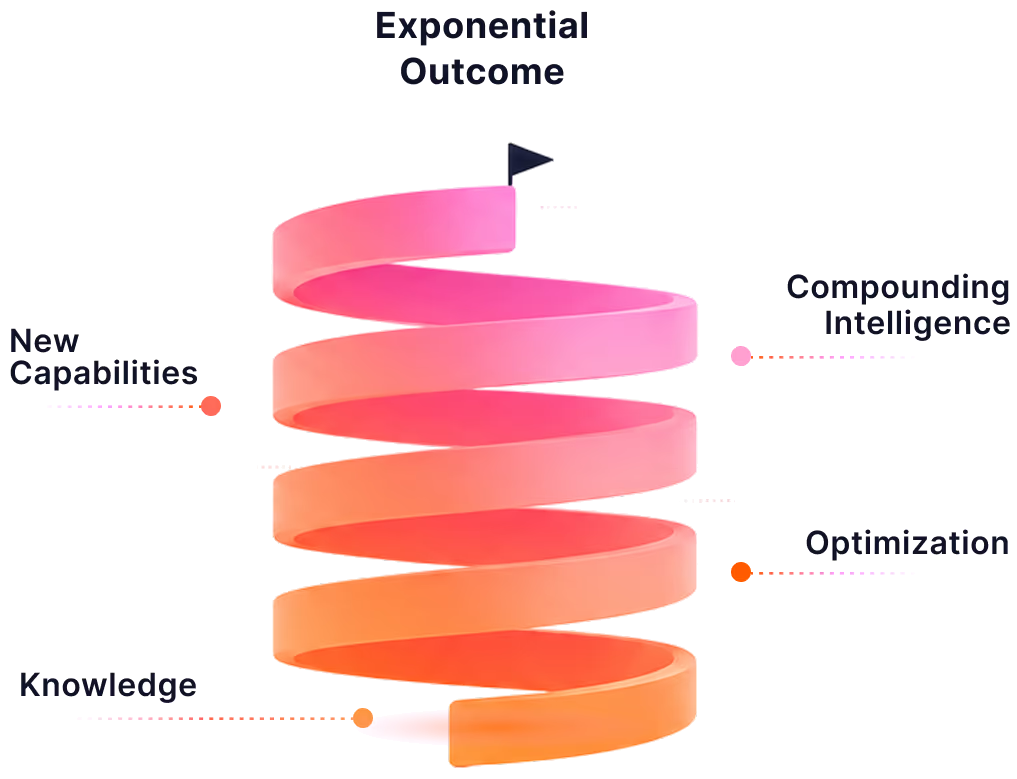
Logistics Design runs on the same governed demand and inventory data RapidCanvas establishes for Demand Forecasting and Inventory Optimization, so it extends the existing engagement rather than starting a new one.
It closes the loop with Production Scheduling and Scenario Planning: the plan that sets what gets built and stocked is the plan the network is routed against.
Each reroute decision and its outcome stays in the model, so lane risk and carrier performance sharpen with every cycle instead of living in a planner's spreadsheet.
New lanes, carriers, and hubs extend the same network model without a separate rebuild.
How to Get Started
Every RapidCanvas solution is built using the same four-stage process. From the system of record to the moment of decision. Four stages, one engine.
Design
Describe your problem in plain language, and the platform turns it into working pipelines and models.
Connect
Access all your business data in place, wherever it lives, without moving or duplicating it.
Launch
Move from Design into your real environment and tools, with experts guiding every key decision.
Govern
Compliance and monitoring run alongside the work, not as a bottleneck at the end.
See the cost of a reroute before you commit the freight.
Bring us the lane that cost you the most last quarter. We will model the alternate routings against your own carrier, transit, and demand data, so the cost delta and transit impact are visible before you reroute.
Book a discovery callGot questions? We're here to answer them for you
Have more questions?
Contact our support team to get what you need.


