RapidCanvas
USE CASE: PRODUCTION SCHEDULING

Maximize throughput with intelligent production planning.

Built for manufacturers running multi-line environments, where changeovers, material availability, and machine downtime can reduce the effectiveness of published schedules within days of issue.

The Scheduling Challenge

Schedule accuracy decays within days of issue.

Many production schedules are designed and released and then overwhelmed by the realities of the factory floor. Changeovers run long, machines require unexpected maintenance, components arrive late, and the schedule is threatened by a set of manual workarounds. Capacity is consumed by unplanned sequencing updates and timelines set by reactive tactics rather than an optimized plan.

Production scheduling / Where the schedule loses fidelity
System Input
  1. Manual input

    Manual Sequencing

    Planners order jobs by hand. Real-time constraint state on the floor stays outside the input.

  2. Trade-off

    Conflicting Parameters

    Throughput, due-date adherence, and changeover cost pull against one another in most sequences.

  3. Judgment call

    Knowledge Gaps

    Experienced planners close the distance to the floor requirement. That judgment stays uncaptured.

  4. Unmeasured

    Capacity Loss

    Changeover time consumes capacity as an opportunity cost that standard OEE reporting leaves hidden.

Next schedule revisionReturns to step 1
Each revision restarts the cycle, and the reasoning behind it stays with the planner.
Solution Capabilities

Deliver a schedule on-time, at-budget and matching demand parameters.

Constraint-aware sequencing does the core work, and the surrounding capabilities determine whether the schedule survives contact with the plant and whether an operator can act without translation.

Optimize sequences across lines for due dates, throughput, and changeover cost, so all objectives are balanced in one pass rather than traded off by hand.
Reorder runs to recover the capacity lost to changeover, which is where high-mix production environments claim the most hours.
Regenerate an optimized sequence within minutes of a disruption, so a machine failure or a late component produces a plan rather than a scramble.
Build machine, material, and maintenance limits into the sequencing logic, so the schedule respects what the plant can actually run.
Surfaces the options behind every schedule conflict, so a plant manager decides with the cost of each path quantified.
Production Scheduler screen showing run sequences and changeovers across three lines, with a flagged order where a component arrives after the run is due to start
Our Solutions Always Employ

The Hybrid Approach™ to Enterprise AI

Human-led, agent-executed, and context-driven by design.

RapidCanvas is the only partner with a Hybrid Approach™ that closes the execution gap between AI potential and real enterprise results by delivering solutions that are outcome-first, context-driven, and expert-optimized.

Agentic automation, custom data apps, access, security, and governance
Enterprise-Grade ArchitectureAgentic Automation | Custom Data Apps | Access | Security | Governance
+
Industry experts, AI engineers, customer success, and cloud-ops
Human ExpertiseIndustry Experts | AI Engineers | Customer Success | Cloud-Ops
Customer Benefits

Production scheduling success is rapid and measurable.

Raise Automated Scheduling Share

More work orders sequence automatically on issue, so planner time moves from building the schedule to deciding the exceptions.

Compress Disruption Response

Revised production schedules arrive in minutes when a sequence is interrupted, with time left to initiate corrective action.

Recover Capacity Lost to Changeover

High-mix environments regain the hours consumed by unoptimized sequencing, which is capacity added without capital.

Capture Scheduling Judgment

Sequencing expertise built over years is held inside the model, so it applies consistently across lines and survives planner turnover.

Expansion Planning

Compounding IntelligenceEach solution makes the next one smarter.

RapidCanvas delivers production scheduling solutions in the context of upstream demand planning and downstream logistics design, with outcomes optimized to your specific business needs.
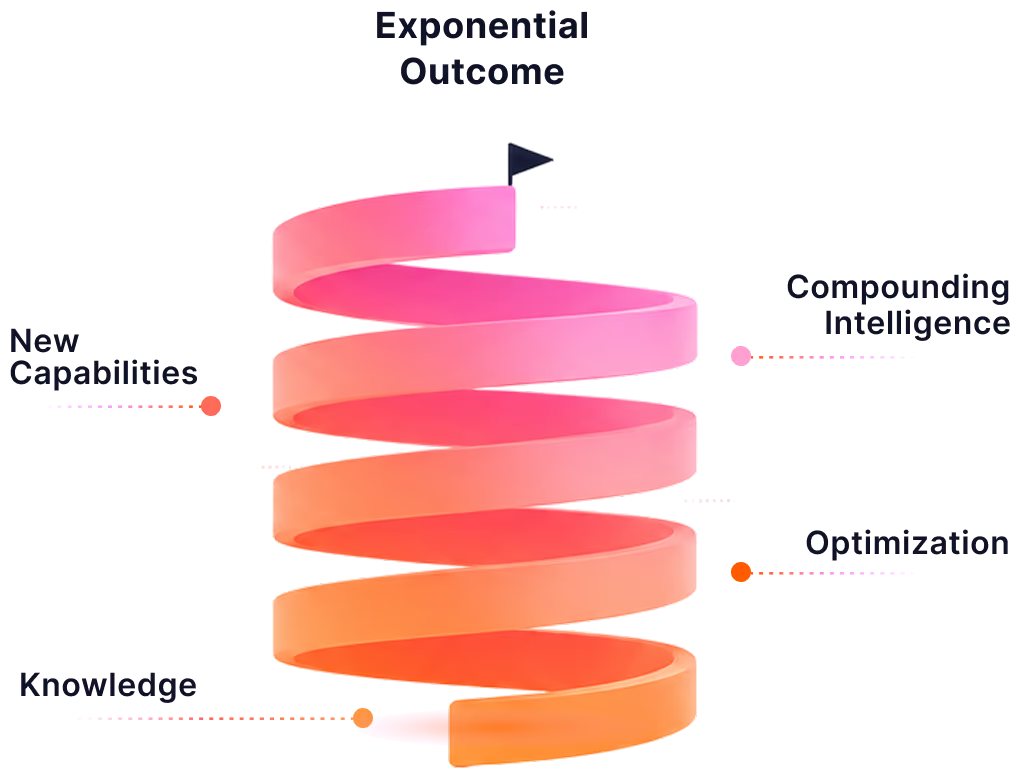
Upward spiral from knowledge to exponential outcomes through optimization, new capabilities, and compounding intelligence

The sequence stays current as the floor changes — every stop, late component, and rush order produces a revised plan instead of a round of manual workarounds.

Scheduling pairs naturally with demand forecasting, since the work orders being sequenced reflect the same governed demand plan used by the production team.

Scenario analysis and capacity planning prices the lines, shifts, and changeovers behind each commitment before the business promises a due date it cannot hold.

Production performance analysis closes the loop, comparing scheduled against actual run times so each cycle's sequence starts from better estimates than the last.

4-Step Process

How to Get Started

Every RapidCanvas solution is built using the same four-stage process. From the system of record to the moment of decision. Four stages, one engine.

1

Design

Describe your problem in plain language, and the platform turns it into working pipelines and models.

2

Connect

Access all your business data in place, wherever it lives, without moving or duplicating it.

3

Implement

Move from Design into your real environment and tools, with experts guiding every key decision.

4

Govern

Compliance and monitoring run alongside the work, not as a bottleneck at the end.

See it on your own production floor.

Bring us the open work orders, machine calendar, and changeover rules for the lines that give you the most trouble. We will show you an optimized run sequence, the capacity recovered from changeover, and the conflicts that need a planner's call.

Book a discovery call

Got questions? We're here to answer them for you

Have more questions?
Contact our support team to get what you need.

AI-powered production scheduling uses advanced algorithms to analyze multiple constraints simultaneously—machine capacity, labor skills and availability, material inventory, order due dates, setup times, and quality requirements. The system evaluates thousands of potential scheduling scenarios in seconds, identifying the optimal sequence that maximizes efficiency while meeting delivery commitments. It accounts for complex dependencies between operations, learns from historical performance data, and continuously refines its recommendations based on actual production outcomes.
Production scheduling solutions benefit discrete manufacturers, process manufacturers, job shops, make-to-order operations, assembly operations, and hybrid manufacturing environments. Whether you're managing complex multi-stage production with hundreds of work centers or coordinating batch processes with strict sequencing requirements, AI scheduling adapts to your specific manufacturing model. Industries like automotive, aerospace, electronics, food processing, pharmaceuticals, and industrial equipment see particularly strong results due to their complex scheduling constraints.
Most manufacturers begin seeing improvements within 8-12 weeks of implementation. Initial gains in schedule efficiency typically appear as the AI learns your production constraints and patterns. Equipment utilization improvements become visible within the first quarter as schedules optimize resource allocation. On-time delivery metrics often improve within 2-3 months. The system continues enhancing performance over time, with many clients reporting peak efficiency after 6-12 months of operation as the AI masters your facility's unique dynamics.
Yes, RapidCanvas integrates seamlessly with major ERP systems (SAP, Oracle, Microsoft Dynamics), Manufacturing Execution Systems (MES), shop floor control systems, quality management systems, and maintenance management platforms. Our solution connects to your existing data infrastructure, pulling real-time information about orders, inventory, machine status, and labor availability. The integration process is designed to minimize production disruption, with our experts handling technical implementation while maintaining your current operations.
The AI system continuously monitors actual production status versus planned schedules and rapidly responds to disruptions. When unexpected events occur—such as equipment failures, quality issues, material delays, or rush orders—the system instantly evaluates impact and generates revised schedules that minimize downstream effects. It prioritizes critical orders, identifies alternative routings, and rebalances workloads across available resources. The system distinguishes between minor delays requiring local adjustments and major disruptions necessitating comprehensive rescheduling.
RapidCanvas provides complete explainability for every scheduling decision. You can see exactly which constraints are driving each recommendation—whether it's capacity limitations, setup time optimization, due date priorities, or resource availability. The system displays trade-offs between competing objectives, highlights bottleneck operations, and shows confidence levels for schedule feasibility. This transparency allows production planners to understand scheduling logic, make informed manual adjustments when necessary, and build trust in AI recommendations.
Absolutely. The platform scales seamlessly whether you're adding new production lines, expanding to additional facilities, increasing product complexity, or growing order volume. The system handles increased scheduling complexity without performance degradation—from single facilities with dozens of machines to multi-site operations with hundreds of work centers. As your operations expand, the AI actually becomes more effective because it has richer data to optimize across. The architecture supports job shops through high-volume production environments.
Accurate production scheduling directly improves customer satisfaction by enabling reliable delivery commitments and reducing late orders. Customers experience more predictable lead times, better order visibility, and fewer expediting emergencies. Optimized schedules also improve product quality by reducing rushed production and allowing proper setup time. The improved on-time performance builds customer trust and strengthens relationships. Better capacity visibility enables more realistic promise dates, preventing overpromising and the disappointment that follows.
Essential data includes work orders or production orders, bill of materials, routing information with operation times, machine/work center capacity, and current WIP status. Additional valuable data includes historical production performance, setup times between product families, labor skills and availability, preventive maintenance schedules, quality data, and material lead times. The more complete your data, the more sophisticated the optimization, but RapidCanvas delivers value even with basic datasets. Our implementation team helps identify critical data sources and establish data collection processes.
The AI system learns from every production cycle by comparing scheduled versus actual performance. It identifies which operations consistently run faster or slower than planned, which setup times are accurate, where bottlenecks emerge, and which sequencing rules prove most effective. This feedback loop automatically refines scheduling parameters, adjusts time estimates, and recognizes patterns in your facility's performance. Over time, schedules become increasingly realistic and achievable as the system masters your unique production environment, operator capabilities, and equipment characteristics.