RapidCanvas
USE CASE: REVENUE & PIPELINE GROWTH

Concentrate commercial effort on the accounts most likely to produce revenue.

Built for B2B sales and revenue teams stuck in static scoring models for growth planning.

The Revenue Challenge

Growth pursued on intuition and relationship rather than evidence.

Most commercial teams define targets from a static plan set during annual planning, then adjust manually without data-driven evidence or traceability. Customer profiles describe which accounts share properties with previous customers and lack insights on account-specific trends, such as purchase history correlation with new offerings.

Revenue & pipeline growth / Where commercial effort loses focus
CRM & Account Data
  1. Firmographic

    Static Profiles

    Ideal customer profiles rest on industry, revenue band, and headcount, with no behavioral or intent input to show which accounts are receptive now.

  2. No ranking

    Equal Priority

    A static profile applied to a firmographic list produces no predictive order, so every account in the segment reaches the seller with the same priority.

  3. Uncaptured

    Patterns Unrecorded

    The CRM holds purchase history and yields no product affinity, no expansion estimate, and no account-level next action.

  4. Misallocated

    Effort Spread Evenly

    Selling capacity goes to low-probability prospects and low-headroom accounts while the strongest opportunities on both sides go unworked.

Next planning cycleReturns to step 1
Solution Capabilities

Score all revenue drivers and match with actionable growth plans.

Sales initiative ranking is calibrated to your engagement processes and metrics. Recommendations are based on practical growth expectations and outreach options.

Ranks prospects by fit and buying readiness against your ideal customer profile, firmographic data, and intent signals, so the model reflects which characteristics predicted a win in this business.
Flags accounts showing research or competitor-evaluation activity and rescores as new signals arrive, which separates the accounts worth a call this week from those that only fit the profile.
Identifies the product combinations with the highest attach rate among comparable customers, turning purchase history into a specific recommendation for each account.
Estimates the growth available in each existing account against comparable customers over a forward window, so effort concentrates where the value is greatest.
Separates accounts ready for immediate sequencing from accounts suited to nurture, and connects each tier to routing so the score determines what happens next.
Attaches the evidence behind each score and a recommended next action to the account record, giving the seller a specific opening and leadership a way to audit the list.
Revenue Growth Advisor screen plotting accounts by fit and buying readiness against expansion headroom, with a recommendation on the account showing competitor evaluation
Our Solutions Always Employ

The Hybrid Approach™ to Enterprise AI

Human-led, agent-executed, and context-driven by design.

RapidCanvas is the only partner with a Hybrid Approach™ that closes the execution gap between AI potential and real enterprise results by delivering solutions that are outcome-first, context-driven, and expert-optimized.

Agentic automation, custom data apps, access, security, and governance
Enterprise-Grade ArchitectureAgentic Automation | Custom Data Apps | Access | Security | Governance
+
Industry experts, AI engineers, customer success, and cloud-ops
Human ExpertiseIndustry Experts | AI Engineers | Customer Success | Cloud-Ops
Customer Benefits

Revenue and pipeline growth is measurable at the segment and account level.

Concentrate Seller Capacity

Effort goes to the accounts most likely to convert, so the same headcount works a list ordered by probability rather than by alphabet or territory.

Raise Contact and Conversion Rates

Outreach follows observed buying activity, so a higher proportion of calls reach an account already evaluating the problem.

Reduce Manual Qualification

Teams work lists that were prioritized before the first call, which removes the daily task of qualifying a universe by hand.

Give Every Call a Documented Reason

Sellers open with rationale specific to the account, and the reason behind each rank remains available for coaching and review.

Expansion Planning

Compounding IntelligenceEach solution makes the next one smarter.

RapidCanvas delivers revenue and pipeline growth in the context of the surrounding sales and revenue intelligence use cases, with the account and signal model shared across each.
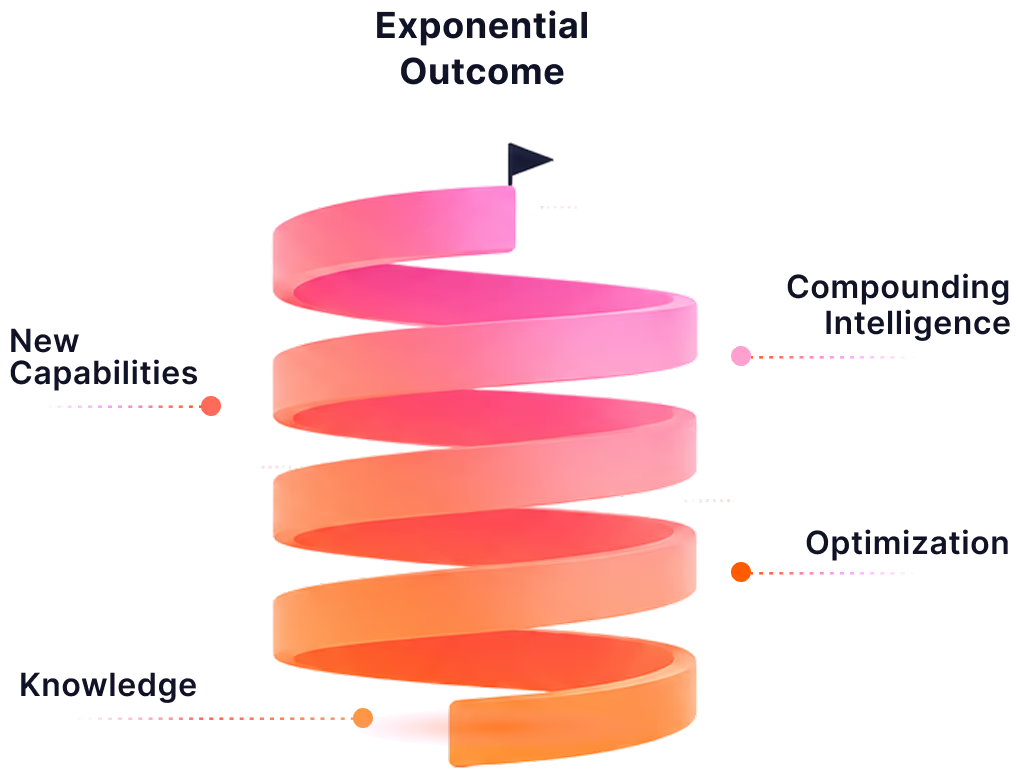
Upward spiral from knowledge to exponential outcomes through optimization, new capabilities, and compounding intelligence

The ranking stays current as intent, engagement, and order data arrive, so the list reflects this week's conditions rather than the last planning cycle.

Prospect scoring pairs with customer segmentation and lead qualification, since each draws on the same governed account and signal model.

Aftermarket and installed-base scoring applies the same method to parts, upgrade, and service propensity for equipment manufacturers.

Quote generation carries a selected opportunity through to a sized, priced configuration, with margin held above the agreed floor.

4-Step Process

How to Get Started

Every RapidCanvas solution is built using the same four-stage process. From the system of record to the moment of decision. Four stages, one engine.

1

Design

Describe your problem in plain language, and the platform turns it into working pipelines and models.

2

Connect

Access all your business data in place, wherever it lives, without moving or duplicating it.

3

Implement

Move from Design into your real environment and tools, with experts guiding every key decision.

4

Govern

Compliance and monitoring run alongside the work, not as a bottleneck at the end.

See it on your own account book.

Bring your closed-won history, a recent account export, and the segments you are targeting this year. We will show you a ranked list with the reason behind each position, and tell you whether the data you already hold supports a working solution.

Book a discovery call

Got questions? We're here to answer them for you

Have more questions?
Contact our support team to get what you need.

It ranks the full revenue universe, prospects and existing customers together, on one scoring method. Prospects are scored on fit and buying readiness, existing accounts on expansion headroom, and every entry carries the documented rationale and a recommended next action. The output is a prioritized list that sales and account teams can work directly.
An ideal customer profile is usually defined on industry, revenue band, and employee count, then applied to a firmographic list and left unchanged until the next planning cycle. It describes resemblance and does not indicate which accounts are receptive now. This solution calibrates scoring to your closed-won and closed-lost history and adds intent and engagement data, so the ranking reflects observed buying behavior.
Core inputs are closed-won and closed-lost history from your CRM, order, invoice, and margin history, and your product catalog and pricing. Firmographic and technographic data define fit, and intent, engagement, and campaign response data indicate buying activity. Scoring can begin on a subset of these sources and be extended as further sources are connected.
Both groups are placed on a common ranking so that commercial effort can be allocated across new-logo and expansion opportunities on the same basis. Prospects are positioned by fit and buying readiness, and existing accounts by the growth available relative to comparable customers. Acquisition and expansion programs then draw on one method, and each informs the other.
It monitors research activity, competitor-evaluation activity, and engagement signals at the account level. An account showing recent evaluation activity is flagged and moved ahead of accounts that match the profile but show no current activity. Accounts are placed in an immediate-sequencing tier or a nurture tier, and each tier connects to a defined outreach routing.
Headroom is estimated by comparing each account with customers of similar profile and purchase history. The model identifies the product combinations with the highest attach rate among those comparable customers and sizes the difference against what the account currently buys. The estimate is scored over a forward window so that account teams can prioritize by potential value.
Yes. The evidence behind each score is attached to the account record together with a recommended next action. Sellers can open a conversation on account-specific rationale, and sales leadership can review the basis for the ordering during pipeline reviews and coaching.
Scores are recalculated as new intent, engagement, and purchase data arrive across the account universe. The list therefore reflects current conditions between planning cycles and does not age into a static export.
It is designed for business-to-business sales, sales operations, and revenue teams in manufacturing, industrial technology, financial services, and construction services. These teams typically compete for growth accounts against larger organizations that have dedicated account-based marketing platforms and data science staff.
The first step is a 30-minute discovery call. Bring the account and pipeline questions that matter most, and RapidCanvas will assess whether the CRM, order, and engagement data you already hold supports a working solution before any project scope is agreed.